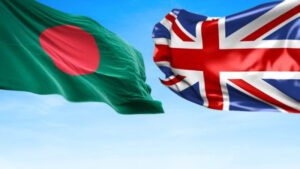
 Dhaka: After gaining Independence on 16 December 1971, the rush to recognize Bangladesh started all over the world. Britain is one of the first western countries to recognize Bangladesh as an Independent country. On 4 February 1972, the United Kingdom recognized Bangladesh as an independent state.
Recognition of Bangladesh as an Independent country was very significant. The reason why this decision was significant in the global politics of that time was that the post-Independence government of Bangabandhu Sheikh Mujibur Rahman was known as “non-aligned” by the contemporary British diplomats and policymakers.
Bangladesh gained Independence in 1971 through the Great War of Liberation with the help of India. The Soviet Union then provided strategic assistance to Bangladesh. The US administration, on the other hand, has largely sided with Pakistani invaders in its “covert involvement” with China against Moscow. Nevertheless, as a far-sighted foreign policy of Bangabandhu, Dhaka adopted a non-aligned policy.
In an interview on the eve of the 50th anniversary of diplomatic relations between the two countries, British High Commissioner to Bangladesh Robert Chatterton Dickson said, “I think the United Kingdom has played a leading role in recognizing Bangladesh due to Bangabandhu’s popularity in London.”
Dixon recalls that during the War of Liberation, Bangladesh had strong political and popular support in Britain. Bangabandhu’s first confidence step in London on 7 January 1972 as a free leader influenced the United Kingdom to recognize Bangladesh as an Independent Sovereign Country.
After being released from Pakistani captivity, Bangabandhu Sheikh Mujibur Rahman first visited London as a neutral place on his way back to newly Independent Bangladesh.
Bangabandhu arrived in London on 7 January 1972. There he met the then British Prime Minister Edward Heath. He held his first press conference there as the founder of Independent Bangladesh.
He then flew back to his beloved Independent motherland via Delhi on a British Royal Air Force Comet jet on January 10.