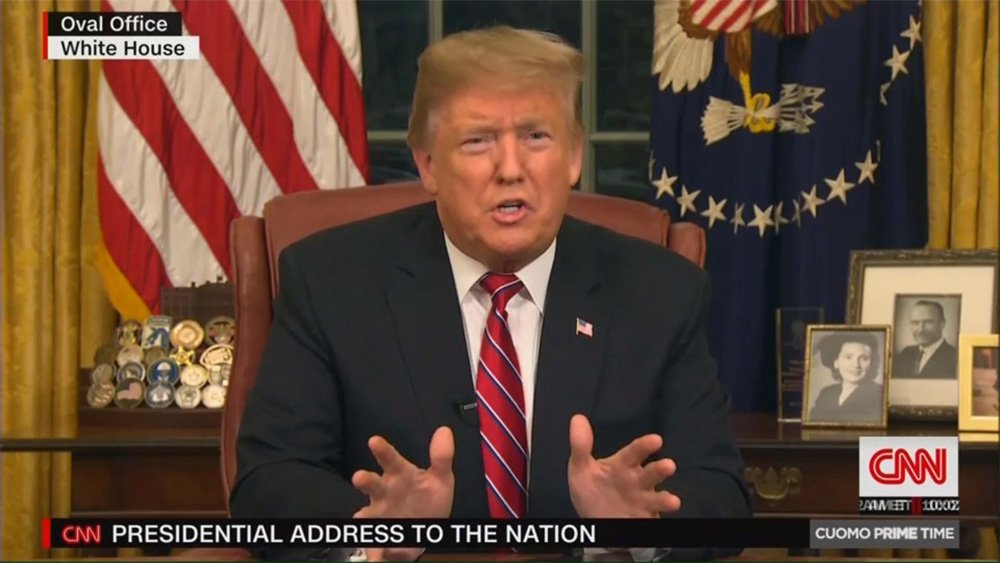
WASHINGTON – President Donald Trump announced that a ban on travelers to the United States from Europe would be in place for the next 30 days, in an attempt to stem the spread of the coronavirus pandemic.
Calling coronavirus a “foreign virus,” Trump attacked Europe for not taking the same actions to control coronavirus that he had. “As a result” of Europe’s inaction, Trump said, “a large number of clusters” of coronavirus “were seeded by travelers from Europe.”
Trump also announced that he would ask Congress for legislative action to provide payroll tax relief, as well as other measures for several groups impacted by the virus.
In addition to legislation, Trump said he would instruct the Small Business Administration to “provide capital and liquidity” to small businesses.
The European Commission did not immediately have a comment on Trump’s announcement.
Trump’s remarks followed a day of deepening market losses and a declaration by the World Health Organization that coronavirus had reached pandemic levels.
As the virus increasingly spreads through the United States by community transmission, however, it is not at all clear that travel restrictions can significantly impact the spread.
Stringent travel restrictions imposed on inbound flights from China to contain the coronavirus outbreak become “irrelevant” in a potential pandemic because “you can’t keep out the entire world,” a top U.S. health official said a day after the Trump administration braced the public for its eventual spread here.
“When it was focused only on China, we had a period of time, temporary, that we could do a travel restriction that prevented cases from coming into the U.S.,” Dr. Anthony Fauci, director of the National Institute of Allergy and Infectious Diseases, told CNBC’s “Squawk on the Street.”
“When you have multiple countries involved, it’s very difficult to do; in fact, it’s almost impossible.”
More than 1,200 cases have been diagnosed in the United States, while there are at least 118,000 cases worldwide.
As markets tumbled Wednesday afternoon, Trump met with representatives of the nation’s biggest banks to discuss economic responses to the epidemic. The president signaled that he is open to a wide range of stimulus proposals, but did not unveil any new plans.
Attendees included Bank of America CEO Brian Moynihan, Wells Fargo CEO Charlie Scharf, Blackstone CEO and Chairman Steve Schwarzman, Citigroup CEO Michael Corbat and Goldman Sachs CEO David Solomon.
The White House has struggled to execute a cohesive plan to stop the spread of the virus. The president has careened back and forth between insisting the coronavirus is no worse than a common flu and demanding that Congress pass drastic financial relief, including a proposed payroll tax holiday.
On Wall Street, the coronavirus-induced sell-off reached new levels as investors grappled with the rapid spread of the virus as well as uncertainty around a fiscal response to curb slower economic growth from the outbreak.
The Dow Jones Industrial Average tumbled 1,464.94 points, or 5.9%, to close at 23,553.22. The 30-stock average closed in a bear market, down more than 20% below the record close set only last month. Wednesday’s close likewise put an end to a market expansion that started in 2009 amid the financial crisis.
Follow all the latest COVID-19 developments on .