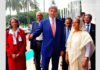
BSS (Montreal, 18 September 2016): Canadian Minister of International Develop-ment and La Francophonie Marie-Claude Bibeau has described Prime Minister Sheikh Hasina as the “pillar of South Asia in women rights and empowerment” as she highly praised Bangladesh's socioeconomic uplift under her stewardship.
The appreciation of Marie-Claude Bibeau, the moderator of the 5th Global Fund Replenishment Conference, came while inviting the Bangladesh premier to deliver her address in the event on Friday. The Canadian minister said there is no need for introducing Sheikh Hasina afresh as she is the “pillar of South Asia in women rights and empowerment”.The two-day 5th Global Fund Replenishment Conference was kicked off at Hyatt Regency Montreal on Friday.
Apart from Sheikh Hasina, Canadian Prime Minister Justin Trudeau, Senegalese President Macky Sall, Togo President Faure Gnass-ingb,, Executive Director of the Global Fund Mark R Dybul and Secretary-General of the Interna-tional Organiza-tion of La Francophonie Micha%lle Jean spoke at the opening session of the conference. Turning to the reflection on the commitments of her government in empowering and engaging girls and women, particularly in the health sector, the Bangladesh prime minister mentioned three points in this regard.
She said her government have firstly placed utmost importance on women's education–the most “powerful tool” for empowering women. “We have made education free for girls up to 12 grade and introduced various types of stipends for them. This has not only resulted in significant improvement in school retention of girls but also reduced under-age marriage, maternal and child mortality,” she said.
Secondly, she said, violence is seriously impacting physical and mental health of women. “We have been maintaining a ‘zero tolerance' against all sorts of violence and discrimination against women,” she said. She said thirdly her government has set up more than sixteen thousand community clinics and union health centers to deliver quality health services in order to serve poor and marginalized sections of the people. “Most of the staff working in these clinics are women,” she said, adding 30 types of medicine are being provided free of cost from these centers.